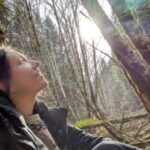
Everything is alive. Not metaphorically — literally, wholly, without exception. The stone underfoot carries memory older than your bloodline. The wind that crosses your face right now has touched every continent since the planet first exhaled. This is not poetry. This is the foundational fact of animistic knowing: the world is a community of people, and you were born already in relationship.
Most of us were not raised inside living cosmologies. We were handed maps that described a world of objects — inert, mute, waiting to be used. The work of returning to the old ways is not about adopting a belief system. It is about remembering a mode of perception that is older than language, one that still lives in the body, in the breath, in the first morning moment before thought narrows the world back down to its familiar dimensions.
The Elements as Ancestors
Before bloodline, before species, before even the green rising of the first plants — there were the elements. Fire, water, earth, air: these are not merely forces or poetic categories. From an ancestral perspective, they are the eldest ancestors, the ones whose bodies you carry in yours right now.
The iron in your blood was forged in a star that died before this solar system existed. The water cycling through your body has been river, cloud, glacier, ocean, tears. The air you are breathing at this very moment has passed through the lungs of every being who has ever lived on this land. You are not separate from these elements — your entire body is built of them.
This is where practice begins: not as a student approaching a subject, but as a younger relative greeting your Elders.
Fire
The Transformer
Fire is the ancestor of change itself. It receives what is offered and returns it transformed — nothing destroyed, only changed in form. To sit with fire is to sit with the oldest ceremonial technology. Before you speak your prayer, let fire know you. Feed it. Watch what it does with what it is given. This is relationship: reciprocal, attentive, without demand for a specific outcome.
Water
The Carrier of Memory
Water remembers everything it has touched. When you stand at the edge of a river, you are standing before an ancestor who has witnessed more of this world’s story than any human lineage. Water does not ask to be honored — but it responds, visibly, when it is. Notice the difference in water that is spoken to with gratitude.
Earth
The One Who Holds
Every ancestor you carry in your blood is held in earth now. When you press your bare feet or hands to soil, you are touching what contains them. Earth is not a symbol of grounding — earth is the body of those who came before, still present, still composting into new life. Reverence is literal. You are meeting the dead when you kneel to the ground.
Air
The Breath Between Worlds
Air carries voice, carries seeds, carries the spores of the fungal nations, carries the dreams of trees. It is the element most intimately inside us — we die within minutes without it. To breathe consciously is to acknowledge the most continuous act of relationship in your life. Every exhale is a gift to the green world. Every inhale is the green world’s gift returned.
The Plant & Fungal Nation
Looking in with this kind of perspective, it is noticed that plants and fungi are not resources or medicine cabinets. They are nations — sovereign, ancient, vastly intelligent in ways that do not resemble human intelligence and therefore have been catastrophically underestimated.
The mycelial web beneath our feet is a nervous system older than any animal nervous system on this planet. The trees it connects are sharing resources, exchanging chemical messages, and sustaining their elders. The birch feeding the shaded hemlock seedling through fungal thread is not altruistic in a human sense — it is its nature. The person understands: this is relationship. This is community. And you are inside it whether or not you acknowledge it.
To establish relationships with the plant and fungal nations, begin with the ones already present in your specific place. Not the exotic, not the rare — the common, the abundant, the ones your land has chosen to grow in great number. Abundance is the land’s way of extending an invitation.
A Practice of Introduction
Go to a plant that grows abundantly where you live. Sit with it without agenda — not to identify it, not to harvest it, not to photograph it. Simply be in proximity and notice what arises. Ask, internally or aloud, if it is willing to be known. Then wait with the patience of someone who understands they are the younger party in this relationship.
Do this over many visits before taking anything. Do this before asking anything. The nations that have been exploited without relationship can feel the difference between extraction and genuine seeking. Your willingness to return without taking is itself a form of ceremony.
The fungi deserve particular attention in this era. They are the decomposers, the recyclers of death into life — they hold the threshold between what has passed and what is becoming. In many traditions, the spirits of the dead travel pathways that bear a striking resemblance to mycelial networks. Whether you hold this literally or cosmologically, it offers a useful frame: to walk with fungi is to walk near the ancestors.
Land Spirits — Learning the Specific Place
The old ways do not happen in the abstract. It happens in a particular watershed, on a particular hillside, in the specific place where your body meets the ground each morning. The spirits of land — what many Indigenous traditions call the genius loci, the character and consciousness inherent to a specific landscape — are not generic. They are as distinct as fingerprints.
This is where much of the Western-adjacent spiritual community loses the thread. It is possible to have a developed relationship with abstract archetypes — Fire as concept, Earth as symbol — while having no relationship whatsoever with the actual land beneath your feet. Connecting with ancestral perspectives, in its truest sense, is relentlessly local. The unnamed stream two miles from your house is more your ancestor-relative than any myth from a tradition not connected to your specific soil.
The land where you live has been in relationship for a very long time — with weather, with other species, with human communities who lived here before you. Your arrival is recent. Approach with the posture appropriate to a newcomer in an established community: introduce yourself, learn the names the land has already been given, understand what was taken and what has been tended.
On Learning a Place
Find out whose unceded territory you inhabit. Learn the Indigenous name of the watershed you live in. Walk the same route every season and notice what changes. Ask: what does this land grow when left to itself? What keeps returning? What wants to return but cannot yet?
These are not rhetorical questions. These are the land speaking its own nature to you. Listening to them is how you begin to know the local spirits as specific beings rather than generic archetypes.
Reciprocity with land spirits takes the form of tending. Not performing ceremony over a place, but actually tending it — removing invasive species, planting natives, carrying water during drought, keeping the pathways clear. The spirits notice what the hands do more than what the mouth says.
The Bloodline — Working with Human Ancestors
Of all the ancestor relationships, the human bloodline is often the most complex — and therefore the most transformative when it is tended honestly. Your biological ancestors are not automatically benevolent simply because they share your blood. They were people: some with great medicine, some with great shadow, most with both in complicated measure.
The old ways of understanding ancestor work is not about putting the dead on a pedestal. It is about establishing a living relationship with those who have passed — one that is honest about what was and what was not. The ancestors who have done their healing on the other side of death wish for their descendants to be well. The ones who have not may pass their unresolved patterns forward through the lineage until someone stops and turns to face them.
You likely carry gifts from your ancestors — ways of seeing, ways of enduring, capacities that were forged in circumstances you will never have to face. You also likely carry wounds — patterns, fears, relational injuries that were not originally yours but arrived through the blood. Both are part of the inheritance. The work is not to reject either but to consciously tend the lineage: acknowledging what was, returning what does not belong to you, strengthening what serves the living and the yet-to-come.
A Threshold Practice
Create a small altar space for your lineage ancestors — those you knew and those beyond living memory. Include water, which they can meet through. Include a light, which signals the way. You do not need elaborate objects: a glass of water and a flame are sufficient.
Speak to them plainly. You do not need formal prayer language. You can simply say: I am here. I know you are here. I want to know you and to know what you carried. Show me what is mine to tend.
Then listen in the ways that are natural to you — in dreams, in what arises during quiet, in what patterns keep appearing in your daily life. The ancestors speak in the language of pattern before they speak in words.
If you feel significant heaviness, distress, or intrusion rather than warmth in ancestor work, seek a skilled practitioner in whatever tradition you walk. Lineage work can surface what needs guidance, and there is no shame in that — it means you have found something real.
All of It, at Once
When you tend the land, you tend the bloodline ancestors who are held in that earth. When you breathe with intention, you breathe with the plant nations that made the air. When you sit with fire, you sit with the element that powered every ceremony your ancestors ever held. The distinctions are useful for learning. The living reality is seamless.
Working from an ancestral perspective does not add a spiritual layer onto ordinary life — it reveals that ordinary life was already saturated with relationships. The cup of water. The meal rooted in soil. The body that needs rest and warmth. These are not interruptions of practice. They are the practice.
You were not born into a world of separate objects. You were born into a conversation that has been going on since the first matter organized itself into something capable of experience. The question of ancestral ways poses is not whether the world is alive — the world is demonstrably alive in ways that exceed our current capacity to measure. The question is: are you willing to live as though the living world can hear you?
Because it can. And it is waiting.